
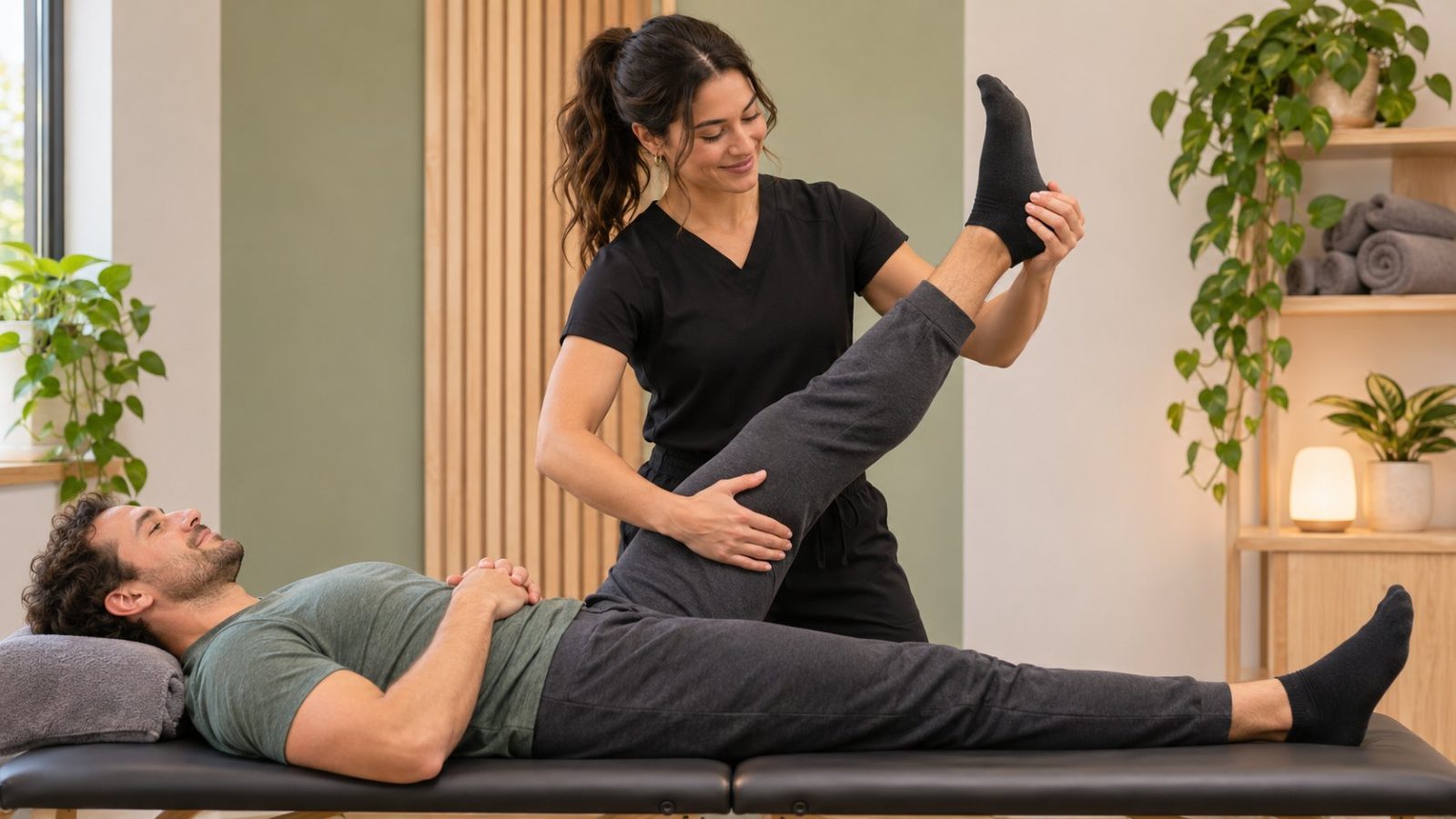
Go Ahead, Let Someone Else Do the Stretching
Be honest: when did you last stretch? Not the three-second hamstring reach before a run, or the dramatic yawn-and-arch at your desk. Properly.
If your answer is "gym class," you are in good company. Stretching is the flossing of the fitness world. Everyone agrees it matters, and almost nobody does it well.
That is exactly why assisted stretch therapy exists, and why we offer it at Purity Health and Wellness in South Edmonton. You show up. Someone qualified does the hard part. It may be the best deal in wellness.
So, what is assisted stretch therapy?
Assisted stretch therapy is a one-on-one session where a trained practitioner stretches you. You lie back and relax. They position, support and guide your body through targeted stretches chosen for your mobility, your flexibility and your goals.
The difference from stretching on your own is simple. When someone else supports the limb, your muscles can actually let go, and you can reach positions that are hard to get into alone. You also get a trained eye picking the right stretch and adjusting it as you go, instead of a routine half-remembered from a magazine in 2009.
Two techniques do most of the work:
- Static assisted stretching. Your practitioner lengthens the muscle and holds it while you stay relaxed.
- PNF stretching. Short for proprioceptive neuromuscular facilitation, which is a mouthful. You gently contract the muscle, then relax as it is eased a little further.
It is not massage, either. Massage applies pressure to soft tissue. Stretch therapy moves your joints through their range of motion. The two pair nicely, and conveniently, we do both.
What happens in a session
No leotard, no incense and no need to touch your toes. A session at Purity looks like this:
- A quick chat. You tell us what feels tight, how you spend your days and what you want to get back to doing.
- A look at how you move. Your kinesiologist checks your mobility and flexibility so the session targets what your body needs, not a generic routine.
- The stretch. You relax on the treatment table, fully clothed, while you are guided through controlled, hands-on stretches. Your only jobs are to breathe and to speak up.
- Constant check-ins. A good stretch feels like a satisfying pull. It should never be painful, and every stretch is adjusted to your comfort level.
- A plan. You leave knowing what was found and what would help next, plus a strong suspicion that you are slightly taller.
Sessions run 30 minutes ($60) or 60 minutes ($105). The shorter visit suits a focused tune-up. The longer one leaves room for a full-body session at a deeper, unhurried pace.
Wear something comfortable that you can move in. Jeans are a bold choice we do not recommend.
Who it helps (short answer: people with bodies)
The clearest finding in the research is that regular stretching improves range of motion. Assisted stretching adds expert guidance, deeper positions and a plan that builds from visit to visit. Here is how that plays out across a lifetime.
Young athletes. Growing bodies and heavy training schedules are a recipe for tight hips, hamstrings and shoulders. Guided stretching supports mobility and recovery between practices, and it teaches good habits before the bad ones set in.
Active adults and weekend warriors. Runners, lifters, golfers, skiers and pickleball converts all ask a lot of their joints. Better range of motion means freer movement in your sport, and a little less groaning on Monday.
Desk workers. Eight hours in a chair shortens the front of your hips and rounds your shoulders. Stretch therapy eases that built-up tension and supports better posture. Your chair will not apologize, but we can help.
Seniors and people with limited mobility. This is where assisted stretching shines. You do not need to be flexible, and you do not need to get down on the floor. Your practitioner does the moving at a pace you set. The goal is practical: making everyday movements like reaching, bending and walking feel easier.
Everyone in between. If you are generally stiff, stressed or simply curious, you qualify. Slow, guided movement with steady breathing is also a rare chance to switch off for half an hour.
One honest note: stretch therapy is not a cure-all, and it does not replace medical care. If you have an injury, ongoing pain or a medical condition, check with your healthcare provider first and tell us about it when you book.
Meet your stretch expert: Rylee Robertson
Stretch therapy at Purity is led by our kinesiologist, Rylee Robertson. Kinesiology is the science of human movement, which makes a kinesiologist exactly the person you want in charge of yours.
Rylee holds a Kinesiology degree from the University of Alberta and is a member of the Alberta Kinesiology Association. She has worked with athletes, children and seniors, so she is equally at home with a teenage hockey player and a grandparent who wants to garden without paying for it the next day.
She has been interested in exercise rehabilitation since she was a kid, and she lives by the idea that exercise is medicine. Her sessions are movement-based, goal-focused and built around the person on the table.
Ready to feel a little looser? Book your stretch
Booking takes about a minute, which is less time than you have spent avoiding stretching today.
- Online: Book Stretch Therapy or book directly with Rylee. You can browse open times without creating an account.
- By phone: (587) 759-6407
- Clinic hours: Monday to Friday, 8:00 am to 8:00 pm. Saturday, 9:00 am to 3:00 pm. Closed Sunday.
- Where: 101 – 1006 103A St SW, Edmonton, AB T6W 2P6
Rylee's appointment times vary within clinic hours, so the online calendar is the best place to see her current openings. If plans change, please give us 24 hours' notice to avoid a late-cancellation fee.
Your body has been carrying you around for years without much thanks. Thirty minutes on the table is a good place to start.